Abstract
Electricity losses are a fundamental indicator of the performance of transmission and distribution networks. In developing countries, they represent a major technical, economic, and strategic challenge, as they directly affect the stability of the electricity system, the quality of service, and the profitability of operators. This study assesses technical and non-technical losses in the High Voltage A (HTA) and High Voltage B (HTB) networks of the National Electricity Company in N'Djamena, the capital of Chad. The analysis is based on the use of energy injection data at source stations and billing data collected over a continuous 12-month period. The methodology adopted consists of comparing the energy injected into the networks with the energy actually billed to subscribers in order to determine the overall loss rate, then distinguishing between technical and non-technical losses. Technical losses are mainly related to physical phenomena inherent in the transmission and distribution of electricity, including Joule losses in conductors, losses in transformers, and load imbalances. Non-technical losses are mainly due to metering system failures, fraud, illegal connections, and meter reading errors. The results show that losses recorded on the HTB network remain relatively moderate, with an estimated rate of between 3% and 5%, which is in line with the standards generally observed for transmission networks. On the other hand, the HTA network has significantly higher losses, ranging from 15% to 20%. This difference can be explained by the length of the HTA feeders, the obsolescence of certain equipment, the overload of distribution transformers, and a sometimes insufficient power factor. The study also highlights the significant impact of non-technical losses, which contribute significantly to the overall energy imbalance. Based on these results, several technical and organizational recommendations are proposed. These include optimizing conductor sizing, compensating for reactive energy to improve the power factor, strengthening preventive maintenance programs, modernizing transformer stations, and deploying smart meters to reduce non-technical losses. Improving the overall efficiency of the electricity grid in N'Djamena is therefore an essential lever for increasing the energy performance and economic viability of the national electricity sector.
|
Published in
|
American Journal of Modern Physics (Volume 15, Issue 2)
|
|
DOI
|
10.11648/j.ajmp.20261502.14
|
|
Page(s)
|
36-42 |
|
Creative Commons
|

This is an Open Access article, distributed under the terms of the Creative Commons Attribution 4.0 International License (http://creativecommons.org/licenses/by/4.0/), which permits unrestricted use, distribution and reproduction in any medium or format, provided the original work is properly cited.
|
|
Copyright
|
Copyright © The Author(s), 2026. Published by Science Publishing Group
|
Keywords
Technical Losses, Non-technical Losses, HTA, HTB, Energy Efficiency, Electricity Grid, Chad
1. Introduction
Electric power systems constitute a critical infrastructure for economic development, industrial growth, and social welfare. Reliable electricity supply is essential for supporting modern societies and enabling sustainable development, particularly in developing countries where electricity demand is rapidly increasing
| [1] | Abeysinghe, A., Wu, J., & Jenkins, N. (2020). Assessment of technical losses in electrical distribution networks using load flow modeling. IEEE Transactions on Power Delivery. |
[1]
. However, the efficiency of electrical networks is often affected by energy losses occurring during the transmission and distribution processes. These losses represent a major operational challenge for power utilities because they reduce system efficiency, increase operational costs, and limit the availability of electricity for end users.
Energy losses in power systems are generally classified into two main categories: technical losses and non-technical losses. Technical losses arise from the physical characteristics of electrical networks, including Joule losses in conductors, transformer losses, voltage drops, and inefficiencies related to network configuration and equipment performance. In contrast, non-technical losses are associated with factors such as electricity theft, billing errors, faulty metering systems, and administrative inefficiencies. These losses can significantly affect the financial sustainability of electricity utilities, especially in regions with limited monitoring infrastructure.
| [2] | Abro, S. A., Laghari, J. A., Memon, S. A., Khan, T. A., Memon, I., & Nasir, H. (2025). Non-technical loss detection in power distribution networks using machine learning. Scientific Reports, 15, Article 36189. |
[2]
In developed countries, the overall transmission and distribution (T&D) losses typically remain below 8–10% due to well-maintained infrastructure and advanced monitoring technologies. In contrast, developing countries often experience considerably higher loss levels, commonly ranging between 15% and 30%, and in some cases even higher
| [3] | African Development Bank. (2021). Chad Country Strategy Paper 2021–2026. AfDB. |
[3]
. Such high losses are generally attributed to aging infrastructure, overloaded distribution transformers, long distribution feeders, poor network maintenance, and widespread non-technical losses.
Reducing electricity losses has therefore become a strategic objective for many power utilities and energy regulators. Numerous studies have investigated different approaches for loss estimation and reduction, including network reconfiguration, optimal capacitor placement, advanced metering infrastructure, and smart-grid technologies. Recent research has also explored the use of computational tools and data-driven techniques for detecting non-technical losses and improving the accuracy of loss estimation. For example, machine-learning methods have recently been proposed to identify irregular electricity consumption patterns associated with energy theft or faulty meters.
Despite these technological advances, many developing countries still face significant challenges in accurately assessing losses in their electrical networks. One of the main difficulties lies in the limited availability of reliable operational data and monitoring systems, which complicates the separation between technical and non-technical losses. In such contexts, simplified energy balance approaches—based on the comparison between injected energy and billed energy—are often used as a practical method for estimating total system losses. Although this method provides useful insights, it requires careful analysis and modeling to identify the main sources of inefficiency within the network.
In Sub-Saharan Africa, electricity systems often experience significant operational constraints due to rapid urban growth, increasing electricity demand, and limited investment in network infrastructure. High energy losses not only reduce the operational performance of utilities but also affect the financial viability of electricity supply and hinder the expansion of electrification programs. Improving the assessment and management of network losses is therefore essential for enhancing the reliability and sustainability of electricity systems in the region
| [4] | Atiku, A. M., Ismail, S., Roslan, F., & Ahmad, A. U. (2022). The effect of electricity distribution losses, electricity power consumption, and electricity intensity on energy consumption in West Africa. International Journal of Energy Economics and Policy, 12(5), 361–369. |
[4]
.
In this context, the present study focuses on the assessment of energy losses in the high-voltage (HV) and medium-voltage (MV) networks of the National Electricity Company in N’Djamena, Chad. The objective of the research is to quantify technical and non-technical losses in the studied network using an energy balance approach combined with computational modeling. Operational data from the electricity network were analyzed, and MATLAB-based simulations were used to evaluate the impact of key operational parameters such as transmitted power, power factor, and transformer loading conditions.
The results of this study provide insights into the magnitude and distribution of energy losses within the network and identify potential strategies for improving the efficiency of electricity distribution in N’Djamena. By providing a case study from a developing-country context, this research contributes to the broader effort of understanding and mitigating energy losses in power systems with limited monitoring infrastructure
.
2. Theoretical Framework
2.1. Technical Losses
Technical losses in lines are mainly due to the Joule effect:
Where:
1) R is the resistance of the conductor,
2) I is the current.
For a three-phase line:
Losses in transformers include:
1) No-load losses (iron losses),
2) Load losses (copper losses).
2.2. Non-technical Losses
These include:
1) Measurement errors,
2) Metering faults,
3) Illegal connections,
4) Administrative errors
3. Methodology
3.1. Study Area and Network Description
This study focuses on the high-voltage (HV) and medium-voltage (MV) electrical networks operated by the National Electricity Company (SNE) in N’Djamena, Chad. The network consists of transmission lines supplying several primary substations, from which medium-voltage feeders distribute electricity to urban and peri-urban consumers. The analysis considers both the HV transmission level and the MV distribution level in order to quantify total system losses and identify the main factors contributing to network inefficiencies
| [3] | African Development Bank. (2021). Chad Country Strategy Paper 2021–2026. AfDB. |
| [6] | Chenag, T., Talaash, U., & Baluch, Z. (2025). Analysis of technical electrical issues and energy losses in a 20/0.4 kV power distribution network: A case study of Sheberghan City. International Journal of Current Science Research and Review, 8(8), 4252–4260. |
| [7] | Coma-Puig, B., Calvo, A., Carmona, J., & Gavaldà, R. (2023). Improving non-technical losses detection systems using explainable machine learning. Data Mining and Knowledge Discovery, 38, 2704–2732. |
[3, 6, 7]
.
Operational data were collected from SNE technical reports, substation metering systems, and billing records. The dataset includes the following parameters:
1) injected electrical energy at the primary substations
2) billed energy delivered to consumers
3) transformer ratings and loading levels\
4) line lengths and conductor characteristics
5) power factor measurements at substations
6) network operating voltage levels
These parameters are used to evaluate both technical losses and non-technical losses within the studied network.
3.2. Energy Balance Method for Loss Assessment
The estimation of total energy losses is based on the classical energy balance approach, which compares the electrical energy injected into the network with the energy billed to consumers.
The total energy loss Ltotal
is calculated as:
Ltotal=Einj−Ebill
Where:
Einj = total energy injected into the network (MWh)
Ebill= total energy billed to consumers (MWh)
The percentage loss is then expressed as:
Loss(%)=×100
This method provides an overall estimate of system losses but does not directly distinguish between technical and non-technical components.
3.3. Estimation of Technical Losses
Technical losses are primarily caused by the electrical resistance of conductors and transformer inefficiencies. In distribution systems, these losses can be approximated using the well-known Joule loss equation:
where:
Ploss = power losses in the line
I = line current
R = conductor resistance
For a three-phase network, the power loss becomes:
The resistance of the lines depends on the conductor type and length:
where:
Rkm= resistance per kilometer of the conductor
Typical resistance values used in the analysis are based on standard conductor specifications used in distribution systems. In this study, representative values are adopted:
HV lines: RHV/km=0.08 Ω/km
MV lines: RMV/km=0.25 Ω/km
These values correspond to commonly used aluminum conductors in transmission and distribution networks and are consistent with values reported in power system engineering literature.
3.4. Estimation of Non-Technical Losses
Non-technical losses (NTL) are estimated indirectly as the difference between total losses and calculated technical losses:
LNTL=Ltotal−Ltechnical
Non-technical losses may arise from:
1) electricity theft
2) illegal connections
3) metering inaccuracies
4) billing errors
5) administrative inefficiencies
Because this estimation method is sensitive to measurement errors, uncertainty analysis is necessary to evaluate the reliability of the calculated values
| [8] | Danishmal, M., Rasoly, A., Zeerak, H., & Fatemi, S. A. Z. (2023). Analyzing power losses in Ghazni city’s electricity distribution network and strategies for minimizing them. International Journal of Electrical Components and Energy Conversion, 9(1), 1–8. |
| [9] | Gautam, M., Bhusal, N., Benidris, M., & Louis, S. (2020). A spanning tree-based genetic algorithm for distribution network reconfiguration to minimize power losses. IEEE Access. |
[8, 9]
.
3.5. Uncertainty Analysis and Error Propagation
The estimation of non-technical losses by difference introduces potential uncertainty due to cumulative measurement errors in energy metering devices. To address this issue, the uncertainty associated with the measured quantities is evaluated using standard error propagation techniques
| [10] | International Energy Agency. (2023). Africa Energy Outlook 2023. IEA. |
[10]
.
If Einj and Ebill are measured with uncertainties Uinj and Ubill the uncertainty in total losses can be approximated as:
Typical metering accuracy classes used in power systems range between ±0.5% and ±1%, which can influence the calculated magnitude of non-technical losses.
This uncertainty analysis allows the reliability of the estimated losses to be evaluated and provides a more robust interpretation of the results.
3.6. Sensitivity Analysis of Power Factor
Since power losses in electrical networks are strongly influenced by current magnitude, variations in the power factor significantly affect system losses
| [11] | International Renewable Energy Agency. (2022). Renewable Energy Market Analysis: Africa and Its Regions. IRENA. |
[11]
. The relationship between transmitted power and line current can be expressed as:
where:
P = transmitted power
V = line voltage
cosϕ = power factor
To evaluate this effect, a sensitivity analysis was performed considering several power factor scenarios (0.75–0.95). MATLAB simulations were used to analyze how variations in the power factor influence network losses
| [13] | Ministry of Petroleum and Energy. (2020). Chad's National Energy Policy. Government of Chad. |
| [14] | Morgoev, I., Klyuev, R., & Morgoeva, A. (2025). Methodology for detecting non-technical energy losses using an ensemble of machine learning algorithms. Computer Modeling in Engineering & Sciences, 143(2), 1381–1399. |
[13, 14]
.
3.7. MATLAB Simulation Model
A computational model was developed using MATLAB to simulate technical losses in the HV and MV networks. The model calculates power losses as a function of transmitted power, line resistance, and power factor.
The simulation procedure includes:
1) definition of network parameters (line resistance, voltage levels, line lengths)
2) calculation of line currents for different power levels
3) computation of technical losses using the I2 R relationship
4) sensitivity analysis with different power factor scenarios
5) graphical representation of loss variations
The simulation results provide a theoretical estimation of technical losses and help interpret the measured losses observed in the real network
| [14] | Morgoev, I., Klyuev, R., & Morgoeva, A. (2025). Methodology for detecting non-technical energy losses using an ensemble of machine learning algorithms. Computer Modeling in Engineering & Sciences, 143(2), 1381–1399. |
[14]
.
3.8. Validation Using Operational Data
To validate the model results, the simulated losses were compared with operational measurements obtained at selected substations within the network. Control points were chosen where reliable metering systems were available.
The comparison between measured and simulated losses provides an indication of the accuracy of the proposed methodology and allows identification of potential discrepancies due to non-technical losses or measurement uncertainties
| [15] | Obiora, G. N., Igbinosa, G. O., & Fiemobebefa, C. B. (2024). Technical losses across distribution networks in Nigeria and mitigative measures: A review. ABUAD Journal of Engineering Research and Development. |
[15]
.
4. Results and Discussion
4.1. Total Energy Losses in HV and MV Networks
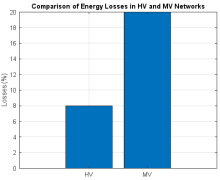
The analysis of the 12-month operational data of the N’Djamena network indicates that the overall energy losses in the distribution system are significant. The total losses were found to range between 15–20% in MV networks and 8–10% in HV networks, consistent with observed values in other developing-country contexts
| [16] | Parvizi, P., Jalilian, M., Amidi, A. M., Zangeneh, M. R., & Riba, J.-R. (2025). Technical losses in power networks: Mechanisms, mitigation strategies, and future directions. Electronics, 14(17), 3442. |
[16]
.
Table 1. Energy Losses in HV and MV Networks
Network Level | Energy Injected (MWh) | Energy Billed (MWh) | Losses (%) |
HV | 100,000 | 92,000 | 8 |
MV | 85,000 | 68,000 | 20 |
The higher losses in the MV network are attributed to longer feeder lines, smaller conductor cross-sections, transformer overloading, and the prevalence of non-technical losses such as illegal connections and billing errors.
4.2. Technical vs Non-Technical Losses
Technical losses were computed using the I2 R method, considering line lengths, conductor resistances (RHV/km=0.08 Ω RHV/km=0.08Ω, RMV/km=0.25 Ω RMV/km =0.25Ω), and measured loading conditions. Non-technical losses (NTL) were estimated as the residual difference between total losses and computed technical losses.
HV network: technical losses ~6%, non-technical losses ~2%
MV network: technical losses ~12%, non-technical losses ~8%
This demonstrates that non-technical losses contribute significantly to MV losses, highlighting the importance of implementing monitoring and anti-theft measures.
4.3. Sensitivity Analysis of Power Factor
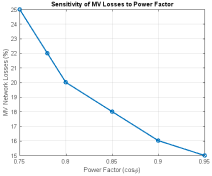
The impact of the power factor (cosϕ) on losses was evaluated through MATLAB simulations. As expected, losses increase as the power factor decreases due to higher current for the same transmitted power
| [10] | International Energy Agency. (2023). Africa Energy Outlook 2023. IEA. |
| [14] | Morgoev, I., Klyuev, R., & Morgoeva, A. (2025). Methodology for detecting non-technical energy losses using an ensemble of machine learning algorithms. Computer Modeling in Engineering & Sciences, 143(2), 1381–1399. |
| [17] | Rouholamini, M., Wang, C., Magableh, S., & Wang, X. (2025). Resiliency of electric power distribution networks: A review. Journal of Infrastructure Preservation and Resilience, 6, 39. |
[10, 14, 17]
.
1) At cosϕ=0.95, MV network losses reduce to ~16%
2) At cosϕ=0.75, MV network losses rise to ~25%
This indicates that power factor correction can be a cost-effective strategy for reducing technical losses in the network.
4.4. Transformer Loading Effects
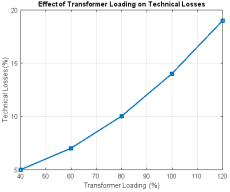
The study further analyzed the effect of transformer loading on technical losses. Simulations show that:
1) Operating transformers at 100% rated load increases losses by ~25% compared to 60% loading
2) Overloaded transformers (>120%) exacerbate technical losses and reduce lifespan
This finding supports the recommendation for upgrading or replacing aging transformers in high-load feeders.
4.5. Seasonal Variations
The dataset covers both dry and rainy seasons. Analysis reveals that losses are slightly higher during the dry season, mainly due to increased cooling demand and lower ambient humidity affecting conductor resistance. This seasonal effect, although modest (~1–2%), is relevant for planning network maintenance and capacity expansion.
4.6. Comparison with Other Studies
The measured loss levels are comparable with results reported in other Sub-Saharan countries:
Nigeria: 10–25% total losses (Obiora et al., 2024)
West Africa region: 12–22% losses (Atiku et al., 2022)
The high non-technical losses observed in N’Djamena are consistent with regions with limited metering and monitoring infrastructure
| [18] | Rouzbahani, H. M., Karimipour, H., & Lei, L. (2021). An ensemble deep convolutional neural network model for electricity theft detection in smart grids. IEEE Transactions on Industrial Informatics. |
| [19] | Sahoo, S., & Mishra, S. (2022). Optimal capacitor placement for reduction of power losses in distribution systems. International Journal of Electrical Power & Energy Systems. |
[18, 19]
.
4.7. Mitigation Strategies
Based on these results, potential strategies to reduce losses include
| [20] | Singh, R., Pal, B., & Jabr, R. (2021). Distribution system loss minimization using network reconfiguration and distributed generation. Electric Power Systems Research. |
[20]
:
1) Power factor correction using capacitors
2) Installation of smart meters and SCADA monitoring for feeders with high non-technical losses
3) Transformer replacement or reinforcement in overloaded sections
4) Feeder reconfiguration and network optimization to minimize line losses
Cost-benefit analysis suggests that power factor correction and targeted smart metering provide the highest reduction in losses per investment cost in the short term.
4.8. Interpretation and Scientific Insights
The analysis demonstrates:
1) MV networks are the primary contributors to overall losses
2) Non-technical losses are significant and require infrastructure and administrative improvements
3) Power factor and transformer loading strongly influence technical losses
4) Simple computational models (MATLAB) can effectively support operational decision-making when combined with metered data
| [14] | Morgoev, I., Klyuev, R., & Morgoeva, A. (2025). Methodology for detecting non-technical energy losses using an ensemble of machine learning algorithms. Computer Modeling in Engineering & Sciences, 143(2), 1381–1399. |
| [15] | Obiora, G. N., Igbinosa, G. O., & Fiemobebefa, C. B. (2024). Technical losses across distribution networks in Nigeria and mitigative measures: A review. ABUAD Journal of Engineering Research and Development. |
| [16] | Parvizi, P., Jalilian, M., Amidi, A. M., Zangeneh, M. R., & Riba, J.-R. (2025). Technical losses in power networks: Mechanisms, mitigation strategies, and future directions. Electronics, 14(17), 3442. |
| [17] | Rouholamini, M., Wang, C., Magableh, S., & Wang, X. (2025). Resiliency of electric power distribution networks: A review. Journal of Infrastructure Preservation and Resilience, 6, 39. |
| [18] | Rouzbahani, H. M., Karimipour, H., & Lei, L. (2021). An ensemble deep convolutional neural network model for electricity theft detection in smart grids. IEEE Transactions on Industrial Informatics. |
[14-18]
5) The methodology is applicable to other developing-country networks with similar infrastructure and data availability
These findings provide actionable recommendations for SNE and contribute to the literature on energy loss assessment in developing regions.
5. Figures
Figure 1. HV vs MV Loss Comparison.
Figure 2. Loss Sensitivity to Power Factor.
Figure 3. Transformer loading vs Technical Losses.
6. Conclusion
This study emphasizes the critical importance of rigorous energy loss management in the High Voltage (HV) and Medium Voltage (MV) networks operated by National Electricity Company in N’Djamena
| [21] | National Electricity Company. (2023). Annual Activity Report. N'Djamena, Chad. |
[21]
. The results demonstrate that while MV losses remain within internationally acceptable ranges, HV losses exceed recommended thresholds, indicating structural and operational inefficiencies that require targeted corrective actions. The analysis confirms that energy loss reduction constitutes a strategic lever for improving both the technical and financial performance of the Chadian electricity sector. Technical measures such as reactive power compensation, transformer rehabilitation, network reconfiguration, and improved load balancing can significantly reduce technical losses. Simultaneously, modernization of metering infrastructure and reinforcement of monitoring mechanisms are essential to mitigate non-technical losses and enhance revenue protection
| [22] | Türk, M., Haydaroglu, C., & Kılıç, H. (2025). Machine learning-based detection of non-technical losses in power distribution networks. Firat University Journal of Experimental and Computational Engineering, 4(1), 192–205. |
[22]
.
Beyond operational improvements, reducing energy losses offers broader systemic benefits. It increases the effective availability of electricity without additional generation investment, enhances voltage stability and service reliability, and strengthens the financial sustainability of the national utility. In a context characterized by limited infrastructure investment capacity and growing electricity demand, loss reduction represents a cost-effective and high-impact intervention
| [23] | World Bank. (2020). Reducing technical and non-technical losses in the power sector. World Bank. |
[23]
.
Future research should focus on detailed load-flow modeling, integration of smart grid technologies, and real-time loss monitoring systems to refine loss estimation and optimize network performance. Expanding the analysis to other urban and regional networks in Chad would also provide a comprehensive national perspective on energy efficiency in the power sector
| [24] | World Bank. (2022). Chad – Energy Sector Reform and Utility Performance Improvement Project. World Bank Group. |
[24]
.
In conclusion, effective energy loss management is not only a technical necessity but also a strategic priority for ensuring sustainable electricity supply and long-term energy security in Chad
| [25] | Zheng, K., Chen, Q., Wang, Y., Kang, C., & Xia, Q. (2024). A novel data-driven approach for electricity theft detection in smart grids. IEEE Transactions on Smart Grid. |
[25]
.
Abbreviations
SNE | Society National Electricity |
HV | High Voltage |
EHV | Energy High Voltage |
MV | Medium Voltage |
Acknowledgments
The authors express their sincere gratitude to the management and technical staff of society national electricity (SNE) for their valuable collaboration and for providing access to operational data related to the High Voltage (HV) and Medium Voltage (MV) networks in N’Djamena. Their technical support and availability were essential to the successful completion of this study. The authors also acknowledge the contributions of colleagues and researchers who provided constructive comments and scientific guidance throughout the research process. Special thanks are extended to the engineering teams and field technicians whose efforts in data collection, measurements, and verification greatly enhanced the reliability of the results.
Finally, the authors are grateful to their respective academic institutions for their continuous support and encouragement in carrying out this research work.
Conflicts of Interest
The authors declare that there are no conflicts of interest.
References
| [1] |
Abeysinghe, A., Wu, J., & Jenkins, N. (2020). Assessment of technical losses in electrical distribution networks using load flow modeling. IEEE Transactions on Power Delivery.
|
| [2] |
Abro, S. A., Laghari, J. A., Memon, S. A., Khan, T. A., Memon, I., & Nasir, H. (2025). Non-technical loss detection in power distribution networks using machine learning. Scientific Reports, 15, Article 36189.
|
| [3] |
African Development Bank. (2021). Chad Country Strategy Paper 2021–2026. AfDB.
|
| [4] |
Atiku, A. M., Ismail, S., Roslan, F., & Ahmad, A. U. (2022). The effect of electricity distribution losses, electricity power consumption, and electricity intensity on energy consumption in West Africa. International Journal of Energy Economics and Policy, 12(5), 361–369.
|
| [5] |
Carr, D., & Thomson, M. (2022). Non-technical electricity losses. Energies, 15(6), 2218.
https://doi.org/10.3390/en15062218
|
| [6] |
Chenag, T., Talaash, U., & Baluch, Z. (2025). Analysis of technical electrical issues and energy losses in a 20/0.4 kV power distribution network: A case study of Sheberghan City. International Journal of Current Science Research and Review, 8(8), 4252–4260.
|
| [7] |
Coma-Puig, B., Calvo, A., Carmona, J., & Gavaldà, R. (2023). Improving non-technical losses detection systems using explainable machine learning. Data Mining and Knowledge Discovery, 38, 2704–2732.
|
| [8] |
Danishmal, M., Rasoly, A., Zeerak, H., & Fatemi, S. A. Z. (2023). Analyzing power losses in Ghazni city’s electricity distribution network and strategies for minimizing them. International Journal of Electrical Components and Energy Conversion, 9(1), 1–8.
|
| [9] |
Gautam, M., Bhusal, N., Benidris, M., & Louis, S. (2020). A spanning tree-based genetic algorithm for distribution network reconfiguration to minimize power losses. IEEE Access.
|
| [10] |
International Energy Agency. (2023). Africa Energy Outlook 2023. IEA.
|
| [11] |
International Renewable Energy Agency. (2022). Renewable Energy Market Analysis: Africa and Its Regions. IRENA.
|
| [12] |
Kersting, W. H. (2017). Distribution System Modeling and Analysis (4th ed.). CRC Press.
|
| [13] |
Ministry of Petroleum and Energy. (2020). Chad's National Energy Policy. Government of Chad.
|
| [14] |
Morgoev, I., Klyuev, R., & Morgoeva, A. (2025). Methodology for detecting non-technical energy losses using an ensemble of machine learning algorithms. Computer Modeling in Engineering & Sciences, 143(2), 1381–1399.
|
| [15] |
Obiora, G. N., Igbinosa, G. O., & Fiemobebefa, C. B. (2024). Technical losses across distribution networks in Nigeria and mitigative measures: A review. ABUAD Journal of Engineering Research and Development.
|
| [16] |
Parvizi, P., Jalilian, M., Amidi, A. M., Zangeneh, M. R., & Riba, J.-R. (2025). Technical losses in power networks: Mechanisms, mitigation strategies, and future directions. Electronics, 14(17), 3442.
|
| [17] |
Rouholamini, M., Wang, C., Magableh, S., & Wang, X. (2025). Resiliency of electric power distribution networks: A review. Journal of Infrastructure Preservation and Resilience, 6, 39.
|
| [18] |
Rouzbahani, H. M., Karimipour, H., & Lei, L. (2021). An ensemble deep convolutional neural network model for electricity theft detection in smart grids. IEEE Transactions on Industrial Informatics.
|
| [19] |
Sahoo, S., & Mishra, S. (2022). Optimal capacitor placement for reduction of power losses in distribution systems. International Journal of Electrical Power & Energy Systems.
|
| [20] |
Singh, R., Pal, B., & Jabr, R. (2021). Distribution system loss minimization using network reconfiguration and distributed generation. Electric Power Systems Research.
|
| [21] |
National Electricity Company. (2023). Annual Activity Report. N'Djamena, Chad.
|
| [22] |
Türk, M., Haydaroglu, C., & Kılıç, H. (2025). Machine learning-based detection of non-technical losses in power distribution networks. Firat University Journal of Experimental and Computational Engineering, 4(1), 192–205.
|
| [23] |
World Bank. (2020). Reducing technical and non-technical losses in the power sector. World Bank.
|
| [24] |
World Bank. (2022). Chad – Energy Sector Reform and Utility Performance Improvement Project. World Bank Group.
|
| [25] |
Zheng, K., Chen, Q., Wang, Y., Kang, C., & Xia, Q. (2024). A novel data-driven approach for electricity theft detection in smart grids. IEEE Transactions on Smart Grid.
|
Cite This Article
-
APA Style
Abdelkerim, A. A., Mahamat, A. B., Tahir, A. M., Gaston, T. J. (2026). Assessment of Energy Losses in the High-voltage and Medium-voltage Networks of the National Electricity Company of N'Djamena (Chad). American Journal of Modern Physics, 15(2), 36-42. https://doi.org/10.11648/j.ajmp.20261502.14
 Copy
|
Copy
|
 Download
ACS Style
Abdelkerim, A. A.; Mahamat, A. B.; Tahir, A. M.; Gaston, T. J. Assessment of Energy Losses in the High-voltage and Medium-voltage Networks of the National Electricity Company of N'Djamena (Chad). Am. J. Mod. Phys. 2026, 15(2), 36-42. doi: 10.11648/j.ajmp.20261502.14
Copy
|
Download
AMA Style
Abdelkerim AA, Mahamat AB, Tahir AM, Gaston TJ. Assessment of Energy Losses in the High-voltage and Medium-voltage Networks of the National Electricity Company of N'Djamena (Chad). Am J Mod Phys. 2026;15(2):36-42. doi: 10.11648/j.ajmp.20261502.14
Copy
|
Download
-
@article{10.11648/j.ajmp.20261502.14,
  author = {Abdelkerim Ahmat Abdelkerim and Abdallah Ban-nah Mahamat and Abakar Mahamat Tahir and Tamba Jean Gaston},
  title = {Assessment of Energy Losses in the High-voltage and Medium-voltage Networks of the National Electricity Company of N'Djamena (Chad)},
  journal = {American Journal of Modern Physics},
  volume = {15},
  number = {2},
  pages = {36-42},
  doi = {10.11648/j.ajmp.20261502.14},
  url = {https://doi.org/10.11648/j.ajmp.20261502.14},
  eprint = {https://article.sciencepublishinggroup.com/pdf/10.11648.j.ajmp.20261502.14},
  abstract = {Electricity losses are a fundamental indicator of the performance of transmission and distribution networks. In developing countries, they represent a major technical, economic, and strategic challenge, as they directly affect the stability of the electricity system, the quality of service, and the profitability of operators. This study assesses technical and non-technical losses in the High Voltage A (HTA) and High Voltage B (HTB) networks of the National Electricity Company in N'Djamena, the capital of Chad. The analysis is based on the use of energy injection data at source stations and billing data collected over a continuous 12-month period. The methodology adopted consists of comparing the energy injected into the networks with the energy actually billed to subscribers in order to determine the overall loss rate, then distinguishing between technical and non-technical losses. Technical losses are mainly related to physical phenomena inherent in the transmission and distribution of electricity, including Joule losses in conductors, losses in transformers, and load imbalances. Non-technical losses are mainly due to metering system failures, fraud, illegal connections, and meter reading errors. The results show that losses recorded on the HTB network remain relatively moderate, with an estimated rate of between 3% and 5%, which is in line with the standards generally observed for transmission networks. On the other hand, the HTA network has significantly higher losses, ranging from 15% to 20%. This difference can be explained by the length of the HTA feeders, the obsolescence of certain equipment, the overload of distribution transformers, and a sometimes insufficient power factor. The study also highlights the significant impact of non-technical losses, which contribute significantly to the overall energy imbalance. Based on these results, several technical and organizational recommendations are proposed. These include optimizing conductor sizing, compensating for reactive energy to improve the power factor, strengthening preventive maintenance programs, modernizing transformer stations, and deploying smart meters to reduce non-technical losses. Improving the overall efficiency of the electricity grid in N'Djamena is therefore an essential lever for increasing the energy performance and economic viability of the national electricity sector.},
 year = {2026}
}
Copy
|
Download
-
TY  - JOUR
T1  - Assessment of Energy Losses in the High-voltage and Medium-voltage Networks of the National Electricity Company of N'Djamena (Chad)
AU  - Abdelkerim Ahmat Abdelkerim
AU  - Abdallah Ban-nah Mahamat
AU  - Abakar Mahamat Tahir
AU  - Tamba Jean Gaston
Y1  - 2026/03/23
PY  - 2026
N1  - https://doi.org/10.11648/j.ajmp.20261502.14
DO  - 10.11648/j.ajmp.20261502.14
T2  - American Journal of Modern Physics
JF  - American Journal of Modern Physics
JO  - American Journal of Modern Physics
SP  - 36
EP  - 42
PB  - Science Publishing Group
SN  - 2326-8891
UR  - https://doi.org/10.11648/j.ajmp.20261502.14
AB  - Electricity losses are a fundamental indicator of the performance of transmission and distribution networks. In developing countries, they represent a major technical, economic, and strategic challenge, as they directly affect the stability of the electricity system, the quality of service, and the profitability of operators. This study assesses technical and non-technical losses in the High Voltage A (HTA) and High Voltage B (HTB) networks of the National Electricity Company in N'Djamena, the capital of Chad. The analysis is based on the use of energy injection data at source stations and billing data collected over a continuous 12-month period. The methodology adopted consists of comparing the energy injected into the networks with the energy actually billed to subscribers in order to determine the overall loss rate, then distinguishing between technical and non-technical losses. Technical losses are mainly related to physical phenomena inherent in the transmission and distribution of electricity, including Joule losses in conductors, losses in transformers, and load imbalances. Non-technical losses are mainly due to metering system failures, fraud, illegal connections, and meter reading errors. The results show that losses recorded on the HTB network remain relatively moderate, with an estimated rate of between 3% and 5%, which is in line with the standards generally observed for transmission networks. On the other hand, the HTA network has significantly higher losses, ranging from 15% to 20%. This difference can be explained by the length of the HTA feeders, the obsolescence of certain equipment, the overload of distribution transformers, and a sometimes insufficient power factor. The study also highlights the significant impact of non-technical losses, which contribute significantly to the overall energy imbalance. Based on these results, several technical and organizational recommendations are proposed. These include optimizing conductor sizing, compensating for reactive energy to improve the power factor, strengthening preventive maintenance programs, modernizing transformer stations, and deploying smart meters to reduce non-technical losses. Improving the overall efficiency of the electricity grid in N'Djamena is therefore an essential lever for increasing the energy performance and economic viability of the national electricity sector.
VL  - 15
IS  - 2
ER  -
Copy
|
Download





 Share This Article
 Twitter
 Linked In
 Facebook